Z7_89C21A40L06460A6P4572G3JN0
 Inglés UdeA - Cabezote - WCV(JSR 286)
Acciones



Z7_89C21A40L0SI60A65EKGKV1K56
Inglés UdeA - EnlaceInteres - JSR(286)
Acciones


Z7_NQ5E12C0L8BI6063J9FRJC1MV4
Signpost
Acciones
Portal U de A
Z7_89C21A40L06460A6P4572G3JQ1
Biojet, a commitment by Universidad de Antioquia to cleaner skies
Acciones
Biojet, a commitment by Universidad de Antioquia to cleaner skies
By: Sergio Alejandro Ruiz Saldarriaga, journalist at the UdeA Communications Department
An interinstitutional project led by UdeA has reached a significant milestone in innovation for the country's energy transition. This project involves developing a prototype to produce biojet fuel, a sustainable alternative meant to replace petroleum-based fuel in airplanes. It is derived from palm oil, which produces one liter of biofuel daily. As a pioneer in Colombia, the project is currently being tested on real microturbines, which paves the way for more sustainable aviation.

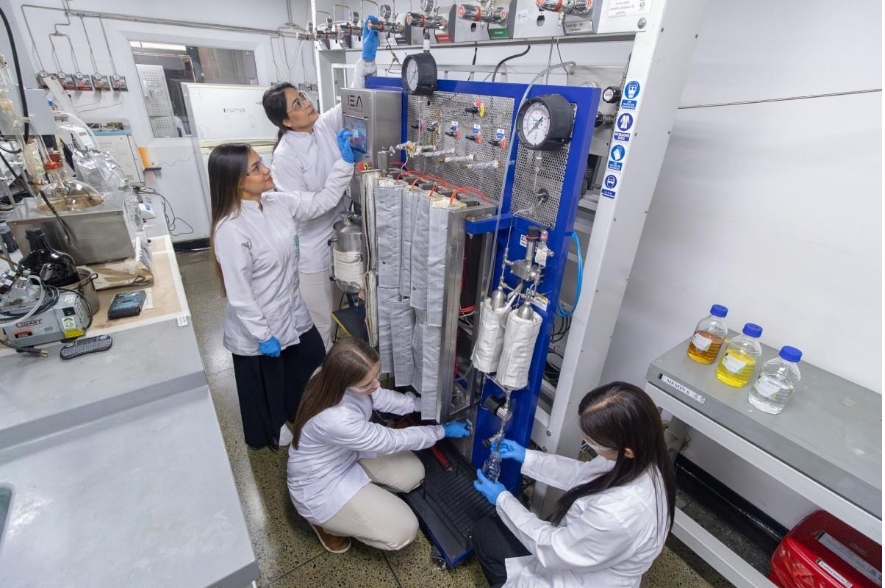
Each gallon of this fossil fuel emits nearly 10 kg of CO₂ into the atmosphere. Biojet can reduce CO2 emissions by up to 90% during its life cycle. Photo: Communications Department/ Alejandra Uribe F.
What began as an academic effort has become a collaborative project in which the university, industry, and the state share a common goal: to produce sustainable aviation fuel in Colombia. Today, there is a prototype that delivers one liter of biojet per day, and while it may seem like a drop in the ocean, it holds the promise of transforming the way the country thinks about its energy.
The project, which has been underway since 2022, is led by the Industrial Chemical Processes (PQI) research group with support from the Efficient Energy Management (GIMEL) group attached to UdeA’s Faculty of Engineering. Universidad de La Guajira, Fedepalma, and IEA Instruments also collaborated on the project. The Ministry of Science, Technology, and Innovation provided financial backing.
Biojet, or Sustainable Aviation Fuel (SAF), is the most promising alternative available to the airline industry today for reducing its carbon footprint. Unlike Jet A-1, which is derived from petroleum, it can be produced from renewable raw materials such as vegetable, animal, or waste oils.
Its use does not require changing engines or infrastructure, and although it currently represents less than 5% of global consumption, organizations such as the International Air Transport Association (IATA) point to it as key to the sector's meeting its environmental goals.
This development is crucial for a country like Colombia, which, under the Paris Agreement, pledged to reduce its greenhouse gas emissions by 51% by 2030.
This is a significant challenge considering that "Colombia consumes between 550 and 600 million gallons of fossil fuel per year, so adopting SAF is not a luxury, but a strategic necessity," said Major Mauricio López, strategic specialist for aeronautical development at the Autoridad Aeronáutica de Aviación del Estado. He also confirmed that the Colombian Air Force (FAC) alone consumes about 10 million gallons of Jet A-1 per year. According to Clean Fuels Alliance America, by 2022, global aviation consumption reached 99 billion gallons.
"The biojet we produce is derived from palm oil, but we are not alone. There are much more robust research groups and powers worldwide working on these biofuels. Even so, there are still technological challenges to overcome, especially in production costs, which are currently higher than their fossil counterparts. The challenge is to develop technology that reduces these costs and enables a viable substitution of conventional fuels," said Luis Alberto Ríos, professor at UdeA’s Faculty of Engineering and director of the PQI group.
The history of this development at UdeA began with the first biodiesel projects the GIMEL group conducted in the early 2000s and the oleochemical research that the PQI group consolidated in 2012. This trajectory led to an inter-institutional project, which aims to leverage technology to produce renewable diesel for ground vehicles and biojet for the aviation sector. This would reduce dependence on foreign patents and lay the foundations for a true energy transition.
From palm trees to sky, this is how UdeA biojet is made
In the face of global criticism of palm oil as a cause of deforestation, researchers emphasize that the Colombian case is different. "Our industry here has not developed by clearing natural forests," Professor Ríos asserted.
The process begins with palm oil, a raw material chosen for its availability in Colombia. According to Fedepalma, the country is currently the fourth-largest producer globally and the largest on the continent. "We proved that palm oil has the greatest benefits for combustion of the oils tested," commented John Ramiro Agudelo, PhD in thermal sciences and researcher in the GIMEL group at UdeA’s Faculty of Engineering.
The first product, renewable or green diesel, is produced through a hydrotreatment process that involves "cleaning" the oil with hydrogen to remove unwanted oxygen. It has already been successfully tested in road vehicles in collaboration with industry partners.
This renewable diesel then enters a second process known as isomerization, during which the molecules are reshaped to better resist cold conditions. "It's the final step that functions like a molecular antifreeze," Professor Agudelo explained. "We altered its structure to guarantee the fuel remains fluid at high altitudes, where temperatures can drop to -50°C, to ensure it complies with strict aviation standards for biojet fuel."
The scaled-up prototype, currently located at the University Research Headquarters (SIU), is a system of tubular reactors, high-pressure pumps, and feed tanks in which oil and hydrogen react. At maximum capacity, it can produce up to 30 liters per day. It has reached Technological Readiness Level 7 (TRL 7*) on a scale of 1 to 9.
It was designed and built with the company IEA Instruments, owned by UdeA graduates. It features a catalyst that, in Professor Rios's words, "does the magic, since it allows the reactions to occur." This technology has been validated under real-world conditions and could be ready for commercial implementation.
A next leap: starting the engines
The GIMEL group is responsible for the fuel's final validation. Its laboratories evaluate the mixtures' performance using a real aviation microturbine, similar to those found in commercial airplanes. "We are the first university in Colombia to test a locally produced biojet on this type of equipment," said Professor Agudelo.
The tests will begin with gradual blends based on a key industry fact: It is currently not feasible to operate aircraft exclusively on sustainable fuel due to strict engine requirements. Therefore, combinations will initially be evaluated in which, for every 100 liters, between 1 and 5 liters of biojet will be included —mixtures of 1%, 2%, and 5%— maintaining conventional Jet A-1 as the base.
The goal is to measure engine behavior and emissions with each increment accurately, and to this end, the researchers include doctoral students to support this process. "Unregulated emissions, which have a high impact on human health, are analyzed," Agudelo added. He emphasized that, if funding continues, the goal is to improve the quality of the biojet obtained, increase the blend percentages, and scale up production for testing on real aircraft engines.
According to the Ministry of Environment and Sustainable Development, the cost of air pollution in Colombia —associated with sources such as transportation, industry, waste management, and the burning of fossil fuels— is estimated at $11.7 billion annually, primarily due to premature mortality and hospital care. Faced with this multisectoral impact, Professor Agudelo emphasized that "human health cannot be balanced in economic terms," and highlighted that initiatives such as biojet production represent concrete progress in reducing the pollution from aviation, one of the sectors most involved in this problem.
For Laura Orozco, co-investigator of the project, the prototype is a tangible result of the UdeA innovation ecosystem. "What we see here is how the knowledge generated in the laboratory can transcend to generate technology-based companies and provide concrete solutions for the country."
While this milestone highlights the development of technologies in the University, the next scaling phase will be crucial to turning this scientific achievement into a viable alternative on the market. However, the risk of repeating what happened with biodiesel two decades ago remains: Importing technology to adapt plants while neglecting local knowledge. "We need continuity, greater funding, and a clear policy that allows academia and industry to work together. The question is not whether we will produce biojet, but whether we will do so with technological sovereignty," warned researcher Ríos.
For his part, Major López agreed that the challenge is not only technical but also concerns public policy. "SAF must be on par with other existing biofuels. To achieve this, Colombia must support the implementation of the first biorefineries and assist investors, with academia as a strategic partner to mitigate the risks in this initial stage."
In this validation phase, the FAC is emerging as a key ally. "With our capabilities, we can support academia with test benches, extensive engine testing, and technical verifications that guarantee flight safety with alternative fuels," said López. He added that the international standards of the American Society for Testing and Materials (ASTM) require approximately 450 cycles to certify the inclusion of a new SAF.
The social impact is also at stake. Researchers propose partnership models in which rural communities can participate in the value chain, considering the country's high availability of raw materials. "It's not just about decarbonizing the sky, but also dignifying the land," Ríos insisted.
The goal is clear: Transforming the country's agricultural wealth into energy value, thus creating local supply chains that benefit everyone, from small farmers to international airlines. It's not just about replacing fuel but building a new economy around it in the country, as other nations have been doing.
The final message is an invitation not to repeat past mistakes. "We can import turnkey technology once the world has already solved the problem, or we can be part of the solution by developing our capacity, knowledge, and industry," Agudelo concluded.
Careful! They are not the same! Biodiesel, renewable diesel, and biojet
-
Biodiesel: Produced through a transesterification reaction, which transforms oil into an ester chemical compound. It is already commercially available in Colombia mixed with fossil diesel currently at 10%.
-
Renewable diesel (green diesel): The result of hydrotreatment. It is a hydrocarbon identical to fossil diesel but of plant or animal origin. It is the first product of the UdeA prototype.
-
Biojet/SAF: Renewable diesel that undergoes an isomerization process to meet strict aviation requirements, such as a low freezing point. This is the final product.
*What is TRL? From the lab to the market
The Technology Readiness Level (TRL) is a scale from 1 to 9 that measures how ready a technology is for commercial use.
-
TRL 1-3: Basic Research. Idea and first laboratory experiments.
-
TRL 4-6: Validation. Prototype in a relevant environment.
-
TRL 7-9: Demonstration. Prototype in a real operational environment. The UdeA biojet project is in TRL 7.
Z7_89C21A40L06460A6P4572G3JQ3
Portal U de A - Redes Sociales - WCV(JSR 286)
Acciones

Z7_89C21A40L0SI60A65EKGKV1K57
Inglés UdeA - Iconos Footer - WCV(JSR 286)
Acciones