Z7_89C21A40L06460A6P4572G3JN0
 Inglés UdeA - Cabezote - WCV(JSR 286)
Acciones



Z7_89C21A40L0SI60A65EKGKV1K56
Inglés UdeA - EnlaceInteres - JSR(286)
Acciones


Z7_NQ5E12C0L8BI6063J9FRJC1MV4
Signpost
Acciones
Portal U de A
Z7_89C21A40L06460A6P4572G3JQ1
UdeA scientists in the discovery of unusual planet-forming disk
Acciones
UdeA scientists in the discovery of unusual planet-forming disk
By: Andrea Carolina Vargas, journalist at UdeA Communications Department
How do planets form? The answer could lie in an unexpected place: a disk of gas and dust in the Lobster Nebula—NGC 6357. A study led by the international consortium XUE, in which Universidad de Antioquia participates, detected a protoplanetary disk rich in carbon dioxide in that nebula. Thanks to thermochemical models —simulations that combine temperature and chemical composition— developed at the University, it was possible to recreate the disk’s behavior and advance our understanding of the conditions that give rise to planetary bodies.

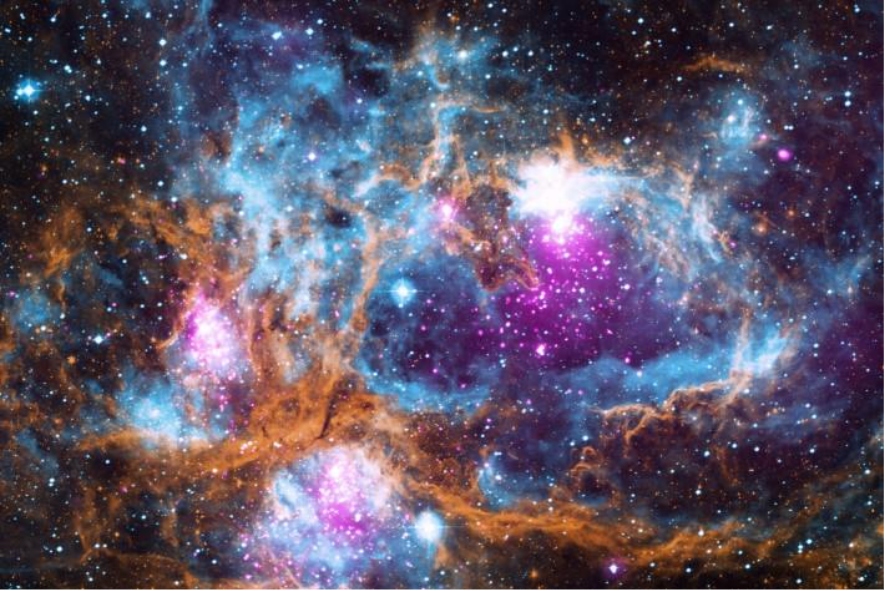 Lobster Nebula. Photo: NASA
In the Lobster Nebula, a highly irradiated star-forming region known as NGC 6357, located 5,500 light-years from Earth in the Milky Way, the XUE consortium detected a protoplanetary disk with an unusual chemical composition: abundant carbon dioxide (CO₂) and little water (H₂O) in regions where, according to current theoretical models, the latter should be plentiful.
"In the region we're studying, many stars are forming, and in this process, a disk forms around each star, and planets are formed in these disks," explained Pablo Cuartas Restrepo, a doctor in Physics and professor at the UdeA Physics Institute, affiliated with the Faculty of Exact and Natural Sciences. These are gas and dust structures that, over time, give rise to planets, moons, and other minor bodies in a stellar system, so their composition is key to understanding how new worlds emerge.
The XUE — eXtreme Ultraviolet Environments — Consortium is an international research collaboration between several universities and research centers, mainly in Europe, and is led by Colombian astrophysicist María Claudia Ramírez-Tannus, a researcher at the Max Planck Institute for Astronomy in Heidelberg, Germany. Universidad de Antioquia is the only Colombian university in this consortium. The sample studied by XUE contains 12 protoplanetary disks around stars with masses between 1 and 4 times that of the Sun.
According to Germán Chaparro, a doctor in astronomy and professor at the Institute of Physics, the composition of these disks depends largely on the type of star surrounding them. In small systems, carbonaceous compounds —carbon-containing molecules such as CO₂— are common, while water tends to predominate in disks surrounding larger stars.
"That's why, in this object with a mass slightly greater than that of the Sun, we expected to find a lot of water, but it doesn't appear. Oxygen is bound to carbon in the form of CO₂, which goes against the trends we know in most of the regions studied," the researcher noted.
This discovery challenges previous observations in astronomy, as it contradicts established models and prompts scientists to reconsider how elements are distributed in space. The case of XUE 10, published in the journal Astronomy & Astrophysics, was documented through a study led by Jenny Frediani, a PhD student at Stockholm University, using data collected by the James Webb Space Telescope (JWST). This infrared observatory, unique in the world, allows for the analysis of light from stellar systems and its decomposition into a spectrum. This makes it possible to identify the molecules that make up those systems.
According to Pablo Cuartas Restrepo, all light —from visible to infrared and ultraviolet— interacts uniquely with each molecule and chemical element. Oxygen has its own way of interacting with light. The same is true of iron, water, carbon, and other elements, which creates unique spectral signatures. In this way, it is possible to determine the components of protoplanetary disks. "The James Webb Telescope captures the light coming from the disks and passes it through a spectrograph, which works like a prism by separating the light into different wavelengths. Each molecule leaves a kind of fingerprint that allows us to identify its presence in the disk," he explained.
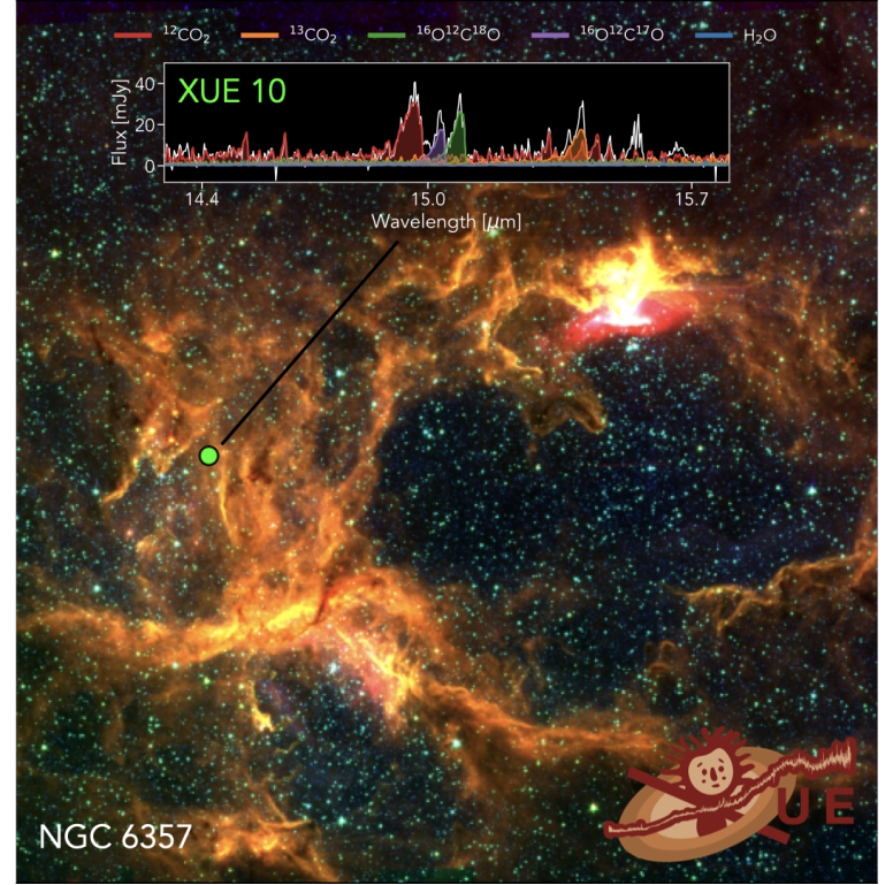
Location of the XUE 10 Protoplanetary Disk. Photo: XUE Collaboration
Thermochemical models to explore XUE 10
Using the data observed and analyzed by the consortium's other members, Universidad de Antioquia researchers, including a PhD student in physics, have been developing thermochemical models that help analyze disks like XUE 10. These synthetic structures allow us to understand how the disk behaves based on its composition and reproduce its physical and chemical conditions.
According to the researchers, the goal is to create models as close as possible to the data observed by the telescope. To do this, multiple physical processes must be considered: thermodynamics, fluid mechanics, the interaction of radiation with matter, gravity, and chemistry, among others. All this information is integrated into Proymo, a computational code developed at the University of Groningen in the Netherlands. Proymo runs on high-powered computers and allows many possible models to run simultaneously.
"We've run a series of simulations with this code, trying to model the chemistry and the different physical and chemical processes to observe the state of the disk and generate synthetic spectra. With the models we're working on, we seek to reproduce the same observational aspect we have and be able to compare them," explained Sebastián Hernández Arboleda, a doctoral student in physics at the Universidad de Antioquia. "A bit of an exaggeration, but thermochemical models are like trying to reconstruct a person's face from just their fingerprint," Chaparro added.
To better understand how thermochemical models are built, think of them as a cake with an unknown recipe that has never been tasted, and its ingredients are inferred only through its aroma. "It's as if we only smelled the cake and, based on those aromas, tested different combinations of ingredients, baking times, and temperatures until we got as close as possible to the original aroma. We can't obtain the exact recipe, but it is possible to come close," explained Professor Cuartas Restrepo.
By applying this approach to the specific case of XUE 10, the thermochemical models generated by the UdeA researchers allow them to explore hypotheses about its unusual composition, such as the abundance of CO₂ and water scarcity. According to the researchers, this helps to propose possible explanations, such as the water being in a solid state, being destroyed by radiation from the nebula, or being in another region of the disk.
Maria-Claudia Ramirez-Tannus, of the Max Planck Institute for Astronomy in Heidelberg, and leader of the XUE collaboration, said: “The discovery of XUE 10 is exciting, as it reveals how extreme radiation environments —common in massive star-forming regions— can disrupt the building blocks of planets. Since most stars and probably most planets form in such regions, understanding these effects is essential to grasp the diversity of planetary atmospheres and their potential for habitation.”
For the researchers at Universidad de Antioquia, the discovery of XUE 10 and the construction of the thermochemical models do not simply describe a particular case. Rather, they open new questions about how planets form and how the essential elements for life are distributed in the cosmos. By challenging known theories and proposing unprecedented scenarios concerning the presence of water and carbon in protoplanetary disks, this work invites us to look further afield: toward the origin of worlds and the conditions that might give rise to life beyond our solar system.
Z7_89C21A40L06460A6P4572G3JQ3
Portal U de A - Redes Sociales - WCV(JSR 286)
Acciones

Z7_89C21A40L0SI60A65EKGKV1K57
Inglés UdeA - Iconos Footer - WCV(JSR 286)
Acciones